How to Test Testosterone Levels: A Practical Guide to Better Timing, Better Labs, and Clearer Answers

Written by
Felipe Gougeon, RN, MPH, BScRS-PT
Author By: Felipe Gougeon, RN, MPH, BScRS-PT
Testosterone testing is often seen as a simple number on a scoreboard. Get a value, compare it to a range, and assume it explains how you feel. In reality, testosterone is a moving target that changes with sleep, stress, training load, alcohol intake, illness, and even the time of day you test. The lab method and the type of sample matter too. That is why two people can follow the same internet checklist or guideline and the take home message can be two totally different conclusions.
What I propose here is a guide designed for real life. It explains how testosterone tests work, when to test, how to prepare, and which related biomarkers can make results easier to understand.
It also covers a common frustration: many at home kits do not offer the full set of supporting biomarkers that clinicians use to interpret testosterone in context.
What testosterone is and what it influences
Testosterone is an androgen hormone involved in multiple systems, including sexual function, sperm production signaling, bone density, muscle maintenance, mood regulation, energy, and red blood cell production. In adult men, most testosterone is produced by the testes in response to signals from the brain. The hypothalamus and pituitary gland play a major role in this signaling pathway.
Because testosterone affects many systems, people often associate a wide variety of symptoms with low testosterone. Some symptoms do overlap with testosterone deficiency, but they also overlap with sleep disorders, thyroid issues, anemia, depression, medication effects, metabolic health problems, and high stress/anxiety states. That overlap is one reason testosterone testing is most useful when it is paired with good timing and supporting labs.
Who might benefit from testing
Testing is often most useful/recommended when someone has persistent symptoms such as:
- Reduced libido or sexual health and desire changes
- Ongoing fatigue that does not improve with improved sleep and better routine
- Reduced recovery, strength, or vitality despite consistent training and good nutrition
- Fertility concerns as part of a clinician guided evaluation
What testosterone testing can tell you
Testosterone test can help answer questions such as:
- Is testosterone potentially contributing to sexual symptoms, such as reduced libido or erectile changes?
- Is testosterone possibly part of persistent fatigue or reduced vitality, when other causes cannot explain it?
- What is my baseline before lifestyle changes or clinician guided evaluation?
- How do key markers look over time during ongoing care when clinically appropriate?
Testosterone test alone cannot do:
- Diagnose a condition without a clinician evaluating physical, history and symptoms
- Explain every symptom you are experiencing
- Provide a guaranteed next step based only on a single number
The goal is to get a result that is as reliable and interpretable as possible, then view it as one part of your overall health picture.
Testosterone naturally varies across the day
Testosterone commonly follows a daily rhythm, with higher levels after sleep/early morning and lower levels later in the day. This is why many clinicians recommend morning testing. A late afternoon test can read lower even in a healthy person, simply due to normal physiology.
Lab methods and reference ranges are not identical
Not all testosterone assays perform the same, particularly near the lower end of the range. Some methods are more prone to variation than others. This matters most when someone is close to the lower limit and trying to understand whether the result is meaningful. It is also why comparing results between different labs or different testing platforms can be confusing. When possible, consistency helps.
Why context labs matter
Symptoms commonly attributed to testosterone can overlap with other health issues. Pairing testosterone with a small set of context labs can reduce guesswork and prevent misinterpretation. Choosing a few high value markers can help clarify what might be causing symptoms.
How to Test Testosterone Levels
Step 1: Choose the right testing format
Blood testing is the standard
The most clinically useful approach is a blood test processed by a regulated laboratory. Blood is usually obtained by venous blood draw. It offers more reliable sample volume, standardized handling, and broader access to related biomarkers.
At home collection can be convenient, but it can be limited
At home kits can be a useful starting point for some people, especially when access to labs is difficult. The tradeoff is that some at-home methods rely on smaller samples, different handling conditions, and a narrower biomarker availability. That does not automatically make them bad, It means you should understand what you are actually getting and what might be missing.
If you want the most interpretable, reliable baseline and the ability to add supporting markers, a standard lab draw is usually the simplest gold standard path.
Step 2: Pick a timing strategy that supports accuracy
A practical rule is to test in the morning. Many clinicians recommend a morning window such as 7 to 11 a.m., depending on scheduling and routine.
If you are a shift worker or you sleep during the day, the idea is still the same: aim to test soon after your main sleep period, not randomly after a long time awake. Consistency matters more than chasing a perfect time that does not match your lifestyle or schedule.
Step 3: Prepare in a way that reduces noise
You do not need a perfect protocol. Prefer to avoid a few common variables that can interfere with results, such as:
Sleep: Try to get a normal night of sleep before testing. A short night, fragmented sleep, or an unusual schedule shift can affect how you feel and may influence hormone signaling.
Acute illness: If you are currently dealing with a significant infection, have a fever, or any acute inflammatory illness, it may be reasonable to delay testing until you are back to baseline (as personal situation allows). Illness can temporarily affect many labs, including hormones.
Training and alcohol: Avoid extremes the day before. If you normally train moderately, do not suddenly do a high level workout. If you normally do not drink, or drink moderately, try not to consume alcohol, or moderate consumption the night before as your pre testing routine. Your goal is a typical baseline day, not a stress test.
Medications and supplements: Do not stop prescription medications on your own. Instead, list everything you take, including supplements and pre workout blends. Some products can affect sleep, stress hormones, and other variables that influence how you feel.
Fasting: Some clinicians prefer morning fasting labs for standardization, while others do not require fasting specifically for testosterone. Follow your clinician’s and lab instructions for fasting.
What biomarkers are typically ordered?
Total testosterone
Total testosterone is the most common starting test. It measures the overall amount of testosterone in your blood, including testosterone bound to proteins and testosterone that is not bound.
This is typically the first number people see and the one most labs report clearly. It is also the number most people compare to reference ranges.
Free testosterone
Free testosterone represents the fraction not bound to proteins. It can be helpful when total testosterone is borderline, or when binding proteins may be affecting how much testosterone is available to tissues in the body.
Free testosterone can be measured using certain methods or calculated using total testosterone plus binding markers.
SHBG
SHBG stands for Sex Hormone Binding Globulin. It is the type protein that binds testosterone. SHBG matters because it influences how much testosterone is free versus bound. Two people can have similar total testosterone and feel very different, especially if SHBG is unusually closer to the high or low levels.
If your goal is a more complete interpretation, SHBG is often one of the most useful supporting markers.
A simple, practical starter panel
If you want a baseline that is still reasonable and not overly complicated, a clinician guided starter approach often includes:
- Total testosterone (morning time)
- SHBG
- Free testosterone, measured or calculated depending on the lab
If symptoms are part of the picture, or for a more comprehensive approach, clinicians often add a few context labs such as:
- CBC, for anemia and general blood health context
- CMP, for liver and kidney markers and overall metabolic context
- Lipids, for cardiometabolic risk context
- TSH, for thyroid screening context
These context labs help separate hormone specific issues from common overall metabolic or inflammatory symptoms.
Home Kits Shortcoming. They Often Miss Key Biomarkers
This is an important point because it affects how useful your results can be.
Many at home testosterone kits focus on a single headline metric such as total testosterone. Some may offer a small expanded panel, however, some cannot run certain biomarkers, either due to sample limitations or because the company does not offer those assays.
Common reasons for limitations
Sample volume and sample type
Many home kits use finger prick blood, capillary blood, or dried blood spot collection. These samples are smaller and can be more challenging for running multiple hormone tests or tests that require specific processing.
Handling and transport constraints
Some biomarkers are more sensitive to time, temperature, or transportation conditions. A venous draw processed quickly in the lab can support more options than a sample traveling through shipping networks.
Narrow testing availability
Some companies simply do not offer certain biomarkers, even if they are clinically useful, because their platform is built around a small set of tests.
Biomarkers that may be missing in some at home kits
Depending on the kit and method, you may not have access to:
- SHBG, which helps interpret free versus bound testosterone
- Free testosterone, especially if SHBG and albumin are not included for calculation
- LH and FSH, which help clinicians understand hormone signaling patterns
- Prolactin, which can be relevant in certain evaluation pathways
- CBC and CMP, which provide broad health context
- A1C, fasting glucose, lipids, and TSH, which help interpreting symptoms that overlap with low testosterone concerns
Practical takeaway
At home testing can be a starter snapshot. If your goal is a complete and clinician driven evaluation, a standard lab draw often makes it easier to include the supporting biomarkers that clarify what your testosterone results mean.
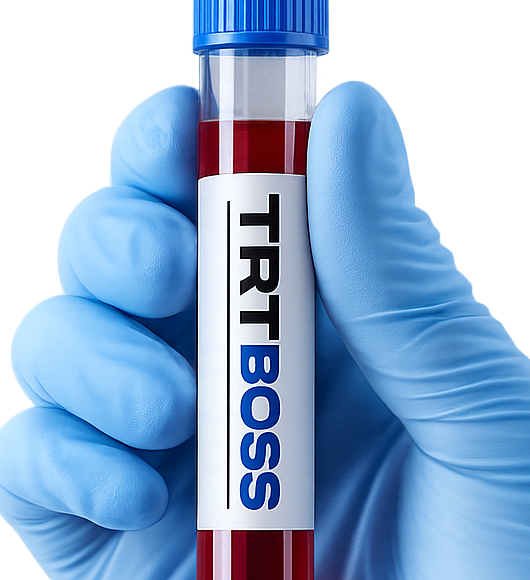
Begin by ordering our TRT Baseline Bloodwork. 38+ Biomarkers with Access to over 2000+ lab locations nationwide.
Interpreting Results – Without Overreacting!
Do not treat the number like a verdict, or a sentence.
A testosterone value is a data point, not a diagnosis and not a personality profile. There is no single number that explains every symptom. Lab reference ranges vary, and individual differences in SHBG can change how total testosterone relates to free testosterone.
Look for patterns and context
When clinicians review testosterone labs, they commonly consider:
- Symptoms pattern and duration
- Sleep quality and schedule
- Body composition and metabolic health – context labs
- Stress levels and recovery
- Alcohol, other substances use
- Medication and supplementation list
- Related biomarkers such as SHBG, free testosterone, and sometimes signaling hormones
Safety and Risks
Common pitfalls that reduce test usefulness
Testing late in the day
Late day testing can read lower due to normal daily rhythm. This can create unnecessary worry and misinterpretation.
Testing after a highly unusual week
If you just traveled across time zones, had a week of poor sleep, have been through a high or higher than normal stress period, your baseline may not be well represented. If your situation allows, test when your routine is closer to normal, or more stable.
Ignoring SHBG and free testosterone context
Total testosterone alone can miss/hide important nuances. If SHBG is abnormal, total testosterone may not reflect free testosterone.
Using internet ranges as medical advice
Online ranges are often disconnected from your lab method, your binding proteins, and your health context. A clinician should interpret results in a safe, evidence informed fashion that fits your specific situation and needs.
Telehealth Process
Telehealth can make hormone testing and interpretation more accessible, especially when it is structured.
A typical TRTBOSS workflow looks like this:
Next steps and guidance from your clinician
Intake focused on goals, physical, symptoms, medical history and medications
Lab guidance and an interpretable panel
Results review that connects labs to your actual context
If you are exploring broader performance and wellness goals begin here.

Medical safety note
If you have severe, rapidly worsening symptoms, a mental health crisis, or any other urgent medical concerns, seek urgent care. Hormone testing is not an emergency tool, and urgent symptoms need prompt evaluation.
Frequently Asked Questions
What is the best time of day to test testosterone?
Morning testing is commonly recommended because testosterone tends to be higher after sleep (early morning) and lower later in the day.
Do I need to fast for a testosterone test?
Some clinicians prefer fasting morning labs for consistency. Others do not require fasting specifically for testosterone. Follow your lab or clinician instructions.
Should I test total testosterone or free testosterone?
Many people start with total testosterone. Free testosterone can be helpful when total testosterone is borderline or when SHBG may be affecting how much testosterone is available.
What is SHBG and why does it matter?
SHBG is a protein that binds testosterone. If SHBG values are more on the high or low levels, free testosterone levels can fall under optimum, even when total testosterone looks consistent and in good levels.
Why do some at home test kits not include SHBG, free testosterone, LH, or FSH?
Some at home kits use small finger prick/capillary samples, and have limited processing options. Some companies also offer a narrow test availability. These factors can limit which biomarkers can be run.
Are at home testosterone tests useful?
They can be a convenient starting point. If results are range borderline, unexpected, or you want a complete evaluation, a standard lab draw often supports a more complete and clinician friendly panel.
What other labs help interpret testosterone related symptoms?
Common context labs include CBC, CMP, lipids, A1C or fasting glucose, and TSH. Clinicians may also consider LH and FSH to understand hormone signaling patterns.
Is there one universal cutoff for low testosterone?
No single cutoff applies perfectly across labs and individuals. Clinicians interpret results using reference ranges, symptoms, SHBG context, and overall health factors.
Can sleep and stress change testosterone results?
Absolutely. Poor sleep and high stress levels can affect how you feel and may influence hormone signaling, which can shift measured testosterone results.
Medical Disclaimer
This article is for educational purposes only and does not provide medical advice, diagnosis, or treatment. Peptide-related therapies may carry meaningful risks and may be inappropriate for many individuals. Decisions about any medication should be made with a licensed healthcare professional who can evaluate your medical history, current medications, labs, and risk factors. If you believe you are experiencing a medical emergency, call emergency services immediately.
Citations & References
Endocrine Society. Testosterone Therapy for Hypogonadism Clinical Practice Guideline. 2018.
Bhasin S, Cunningham GR, Hayes FJ, et al. Testosterone Therapy in Men With Hypogonadism An Endocrine Society Clinical Practice Guideline. Journal of Clinical Endocrinology and Metabolism. 2018.
Centers for Disease Control and Prevention. Clinical Standardization Programs Hormones. Testosterone standardization and reference methods resources.
Centers for Medicare and Medicaid Services. Clinical Laboratory Improvement Amendments CLIA overview and laboratory quality standards.
Cleveland Clinic. Educational resources on testosterone deficiency evaluation and timing considerations.
Most Popular Products

Testosterone Replacement Therapy TRT
- Starting at $99 a month
- Prescription testosterone therapy
- From Licensed U.S. Pharmacies
Enclomiphene Therapy
- Compounded oral capsule
- Stimulates natural production
- Alternative to injections
hCG Human Chorionic Gonadotropin
- Starting at $159 a month
- FDA Approved Commercial Grade
- Shipped by Licensed U.S. Pharmacies
Written by Felipe Gougeon, RN, MPH, BScRS-PT
Felipe Gougeon, RN, MPH, BScN, BScRS-PT, is a health care provider/consultant with over eight years of experience in clinical operations, public health, and quality improvement. He supports telehealth services with a focus on operational efficiency, patient-centered care, and evidence-informed clinical processes.
Drawing on expertise in population health, program implementation, and rapid-response health operations, Felipe works to strengthen care delivery models in virtual health environments.
He is particularly committed to advancing equitable access to care and integrating social determinants of health considerations into service design and delivery.
Related Articles

Felipe Gougeon, RN, MPH, BScRS-PT in Testosterone
How to Test Testosterone Levels: A Practical Guide to Better Timing, Better Labs, and Clearer Answers
Table of contents What testosterone is and what it influences Who might benefit from testing What testosterone testing can tell you Testosterone naturally varies across the day Lab methods and reference ranges are not identical Why context labs matter How to Test Testosterone Levels Step 1: Choose the right testing format Blood testing is the […]

TRTBOSS Editorial Team in Sexual Health
Research Grade” vs Patient-Intended Peptides: What “Physician Use Only” Really Means (and Why Supervised Care Matters)
Introduction to Peptides Peptides are short chains of amino acids that can act as signaling molecules in the body. In clinical medicine, some peptide-based medications are regulated prescription drugs, while other peptide products exist in a gray market, often advertised online as “research grade,” “not for human consumption,” or “physician use only.” Those labels can […]

TRTBOSS Editorial Team in Blood Panel
Why Insurance Often Doesn’t Cover GLP-1 Medications for Weight Loss (and What TRTBOSS Does Instead)
If you’ve looked into GLP-1 receptor agonists (and related “incretin-based” medicines) for chronic weight management, you may have run into a frustrating reality: many insurance plans won’t cover them for weight loss, even when a clinician agrees the medication could be appropriate. This is not simply a paperwork problem. Coverage decisions for weight management medications […]
Start Your Health Assessment Today
Personalized telehealth treatments tailored for you.